TL;DR
- “One monolithic ERP as the only source of truth” is often a sales story — many suites are still bolted-together modules under one logo.
- If your edge is how you operate, force-fitting a rigid SaaS template costs more than licence fees: you lose process advantage.
- Odoo Community gives you modular apps, a large Apps Store, and full source control — with zero per-user licence on the core.
- “Never customise” was sensible when custom code was slow and fragile. With disciplined modules and AI-assisted delivery, targeted customisation is often the point.
- Still deciding? Download the SME ERP cheat sheet, or read ERP vs best-of-breed and ODOO vs custom.
For years, enterprise software vendors sold a simple story: put everything in one ERP and you will have a single source of truth. For some vanilla mid-market finance shops, a big suite still works. For many growing South African businesses, that story becomes a trap — high subscriptions, slow change, and workflows bent to fit the software instead of the other way around.
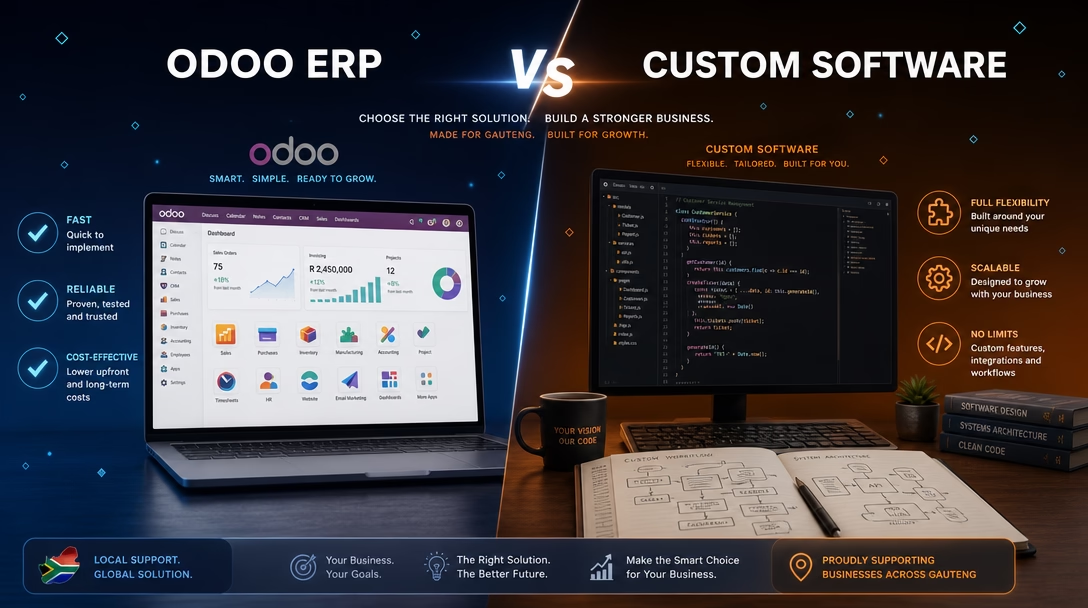
This piece sits next to our ERP vs best-of-breed guide (one suite vs specialist apps) and ODOO vs custom development (configure a platform vs write your own). Here the question is simpler: rigid lock-in versus agile, ownable software.
What is the rigid ERP trap?
The trap is buying a closed, expensive “all-in-one” because the brochure says it is integrated — then discovering you still pay for consultants, workarounds and compromises whenever your real process does not match the template.
Large suites are often assembled from products built by different teams over years of acquisition. You get one login and one invoice. You do not always get seamless process design. SMEs feel that as: long implementations, certified-consultant dependency, and licence costs that climb as headcount grows.
How do the big names actually feel for SMEs?
Use this as a orientation map, not a quote. Indicative list pricing is global USD; your ZAR total cost of ownership still includes implementation and change management.
| System | Strength | Weakness for many SMEs | Pricing shape (indicative) |
|---|---|---|---|
| NetSuite | Strong cloud financials for “vanilla” ops | Rigid when processes are unusual; subscription escalates | Often $1,400+/mo entry before full stack |
| SAP Business One | Brand depth, serious CRM/analytics | Steep learning curve; high TCO for custom work | Per-user + heavy implementation |
| Dynamics 365 BC | Fits Microsoft-heavy wholesalers | Can feel fragmented; AL customisation is not “quick tweak” | Roughly $70/user/mo Essentials class + project fees |
| Oracle ERP Cloud | Enterprise AI and scale | Overkill complexity and price for most SMEs | Roughly $150/user/mo class |
| Odoo Enterprise | Modular apps + Studio | Per-user licence still scales with team size | Roughly $25–$59/user/mo class |
| Odoo Community | Full source, self-host, no core user fees | Needs hosting skill or a partner | Software $0; you fund host + implementation |
Odoo’s third-party Apps Store is the WordPress-like ecosystem for connectors and vertical add-ons — prefer vetted apps before writing code.
Why did consultants say “never customise”?
Because on proprietary platforms, customisation meant expensive SDKs, upgrade breakage, and lock-in to the same vendor’s certified bench. Avoiding custom code protected budgets.
That advice still applies to reckless core hacks. It does not mean your competitive workflow must die on the altar of “vanilla.” On open-source Odoo Community, well-structured Python modules extend standard models, live on staging first, and ride upgrades when you treat them like product — not sticky tape.
AI-assisted development changes the economics: partners who already know Odoo can design, implement and review modules faster. It does not replace architecture or testing. It does make “fit the software to the business” affordable again for SMEs who used to be told they were too small to customise.
When is Odoo Community the smart move?
Choose Community when you want:
- Control — your data, your host (South Africa or elsewhere), your upgrade cadence
- Modular growth — start with CRM and accounting, add inventory or field service later
- Deep customisation — the process is the product (see our Konstructo Odoo field-service case study)
- Budget redirected — spend on workflows and training, not per-seat rent forever
Choose Enterprise or another suite when you specifically need Enterprise-only apps, official Odoo Online constraints, or a vendor-certified vanilla path your board already mandated.
When Odoo itself is the wrong shape — for example South African rental trust and bank ports — we say so and build purpose-built software (RentFlow) under custom development.
What should you do next?
- Download the SME ERP cheat sheet for a one-page comparison.
- Skim ERP vs best-of-breed if your fork is “one system vs many apps.”
- Skim ODOO vs custom if your fork is “configure vs write.”
- Book an ERP consultation — we will map your high-value workflows and recommend Community, Enterprise, hybrid or custom without a vendor script. Or see our ERP implementation services for scope and deliverables.
Your ERP should be a launchpad for how you win work — not a cage you rent monthly.