TL;DR
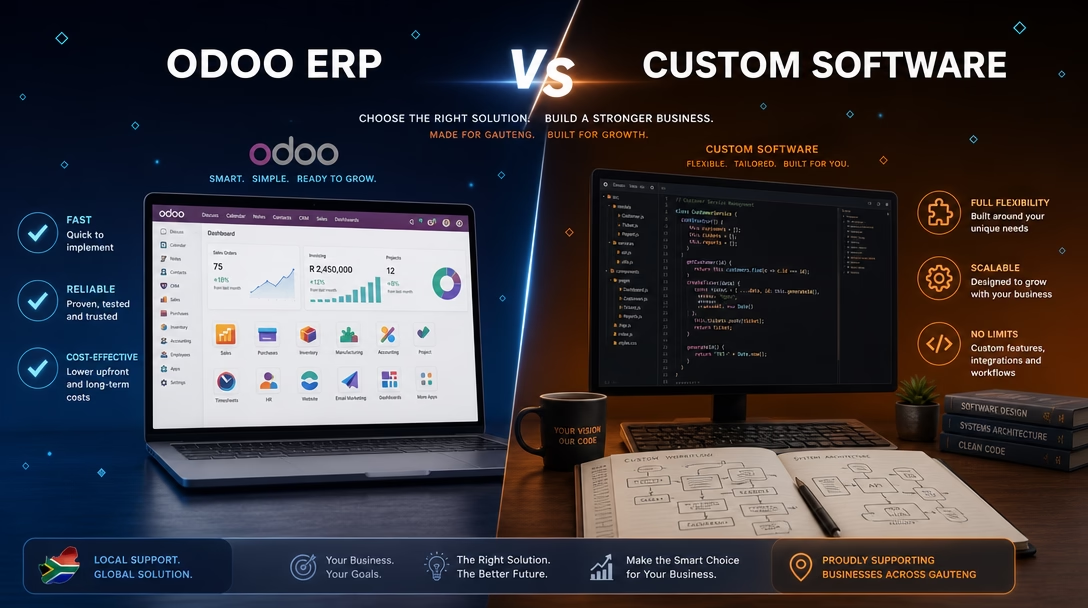
- Choose ODOO when your core workflows are industry-standard and you need to go live in weeks, not months.
- Choose custom when the operation is genuinely unusual, and a packaged product would force a bad fit.
- Most growing businesses land on customised ODOO: standard modules for finance and stock, custom code only where it earns its keep.
- Typical budget bands: R100k–R500k for a serious ODOO implementation, R500k+ for a full custom build (ranges, not quotes).
- Still unsure? Start with a process discovery session, not a vendor demo.
Your business is growing. Sales are climbing, the team is expanding, and the spreadsheets and disconnected systems that got you here are starting to creak. You know you need a proper ERP. Then you hit the real question: go with a packaged platform like ODOO, or build something custom?
It is not a simple choice. The wrong one costs time, money, and momentum. Below is the framework we use with clients, plus a real national build where custom was the right call. This sits next to our ERP vs best-of-breed piece: that article is “one system vs many specialist apps,” and it now includes a short video explainer. This one is “configure a platform vs write your own.”
When should you choose ODOO over custom development?
Choose ODOO when your core workflows look like most companies in your industry and you need a working system in weeks, not months.
ODOO is an open-source ERP with modules for accounting, inventory, CRM, manufacturing, HR, and more. A well-planned implementation maps your processes, configures the modules you need, migrates data, trains the team, and gets you live without funding a greenfield build before anyone can raise an invoice.
You also pay for implementation, configuration, and training rather than years of development time. For many SMEs that makes ODOO the clear financial winner in year one. Common workflows (invoicing, procurement, order-to-cash, manufacturing BOMs) already have established configurations, and the open-source ecosystem brings modules, updates, and a broader support talent pool.
The trade-off: you adapt the business to the platform on the core. ODOO is flexible, but it has guardrails. If you run a genuinely unique process, you either compromise or pay for heavy customisation that erases the cost advantage. That is the work we scope under ERP implementation.
What does custom ERP development actually buy you?
Custom ERP development buys you a system shaped around how the business actually runs, with no platform licence ratchet, when the packaged fit is honestly too poor.
Every screen, workflow, and report can match your operation. You own the code: no per-user licence climb, no forced migration when a vendor deprecates a module. A custom system can also encode proprietary pricing, compliance, or fulfilment rules in a way off-the-shelf products will not copy. That can be a moat.
The trade-off: custom takes longer and costs more upfront, often significantly more. You fund months of design, development, and testing before you see ROI, and you carry maintenance, updates, and security. There is no community catching the next CVE for you. When that path is right, we deliver it under custom development.
How do you decide between ODOO and a custom build?
You decide on three factors: how unique the processes are, how fast you need to go live, and how you expect to grow.
How unique are your processes?
If core workflows look like most companies in your industry (buy, stock, sell, invoice, pay), ODOO will handle them out of the box or with light configuration. Custom development is overkill.
If you have genuinely unusual operations (specialised compliance, proprietary pricing, an unconventional supply chain), custom may be the only clean path, or a targeted custom module on top of ODOO.
Rule of thumb: if you can describe the core process in a standard flowchart, ODOO can handle it. If you need three paragraphs to explain why it is different, talk to a developer before you buy a platform and hope.
How fast do you need to go live?
Need a working system in two months? ODOO. Even a phased rollout gets you live faster than a custom build from scratch.
Have six to twelve months and a bigger budget? Custom becomes viable. You trade speed for precision.
How will you grow?
ODOO scales well for most SMEs. Modular architecture lets you add manufacturing, ecommerce, or field service as you grow. At a certain scale, per-user licensing and configuration limits can start to pinch.
Custom systems scale without that licence line, but you pay for every new feature in development time. There is no module marketplace.
Is customised ODOO the middle path most businesses should take?
Yes. Most growing businesses end up on customised ODOO, and it is often the smartest choice.
Instead of pure vanilla ODOO or a full custom build, you implement ODOO with targeted custom development where it matters. Core financials and inventory run on standard ODOO. The unique quoting process or industry-specific compliance report is built as an ODOO module.
You get the speed and cost of a proven platform, with custom code only where it earns its keep: process mapping, ODOO configuration, and modules that extend the platform without breaking upgrades. When the operation is too specialised for a packaged product, we build the system instead of forcing a bad fit.
What did a real national Odoo field-service build look like?
For Konstructo, heavily customised Odoo 18 Community was the right call — not a forced vanilla install, and not a greenfield rewrite from scratch.
Konstructo is a South African contractor with field teams on sites from Johannesburg to Durban, Cape Town and beyond. They were on a patchwork of spreadsheets, legacy software and paper for job intake, scheduling, materials, timesheets, invoicing and compliance. Revenue was leaking through missed variations and late billing.
African Vanilla mapped those workflows, then extended Odoo helpdesk and field service with inbound work-order parsing, job creation, technician tools, billing packs tied to sales orders and invoices, proof-of-delivery evidence, and national ops visibility. Standard modules carry finance and stock patterns; custom code covers what makes their contracts unique.
Published results from that Konstructo case study:
- 40% reduction in administrative overhead for scheduling and billing
- Real-time visibility across all active sites for the first time
- Faster, more accurate invoicing and fewer disputes
- National expansion without proportional admin growth
- Zero lost billable hours due to missed variations since go-live
The case study does not quote a change-request turnaround in hours or days, so we will not invent one. What it does document is ongoing managed support and further module development by the same team that mapped the sites. That is the change speed we can stand behind on a live national system: people who know the workflows, shipping further Odoo modules — not a rewrite every time a variation process changes.
How do the budget and timeline ranges compare?
Typical ranges look like this. They are not a quote.
| Factor | Go ODOO | Go custom |
|---|---|---|
| Core processes | Standard industry workflows | Highly unique operations |
| Budget (typical) | R100k–R500k implementation | R500k+ for a full custom build |
| Timeline | Weeks to a few months | 6–18 months |
| Team size | 5–200 users | Any size; licence cost is the lever at scale |
| Maintenance | Partner + community | Your team owns it all |
Your number depends on data quality, number of companies, and how much of the business is actually unusual. We will not pretend a discovery call is a fixed-price ERP.
What should you do next?
Book a discovery session before you buy a platform or open a greenfield ticket.
Map the current processes, name the pain, and get a qualified view of which path fits. Book a free consultation. No lock-in. No pressure. A clear view of ODOO versus custom for your operation.